Does your cloud bill feel like a fast food habit?
A thought hit my mind while making breakfast on one fine morning. The same breakfast costs ten to twenty times more if I buy it out, and I don’t have to move a pan. So I’m not paying for breakfast. I’m paying for convenience. Except I still have to get dressed and drive there before I can eat it. Which makes me wonder whether it’s convenience at all, or just the feeling of it.
In college I ate out constantly, because it felt cheaper and easier. A few months in I worked out that it wasn’t going to hold, and I’d have to learn to cook. I struggled at first. Eventually it turned me into a decent cook (my opinion, not my wife’s), and it was better for both my health and my wallet.
The excitement of the first order
Ordering in wins the first few times, and for good reason. You don’t build a kitchen or tie up capital in appliances you’ll use twice, and no midnight cleanups.
The same holds for public cloud. If you’re a startup with demand you can’t predict, or an enterprise with genuinely bursty workloads, renting is the right answer.
The problem was never the first meal. It’s that you priced one meal and then ordered 1,825 of them.
The answer is in the bill
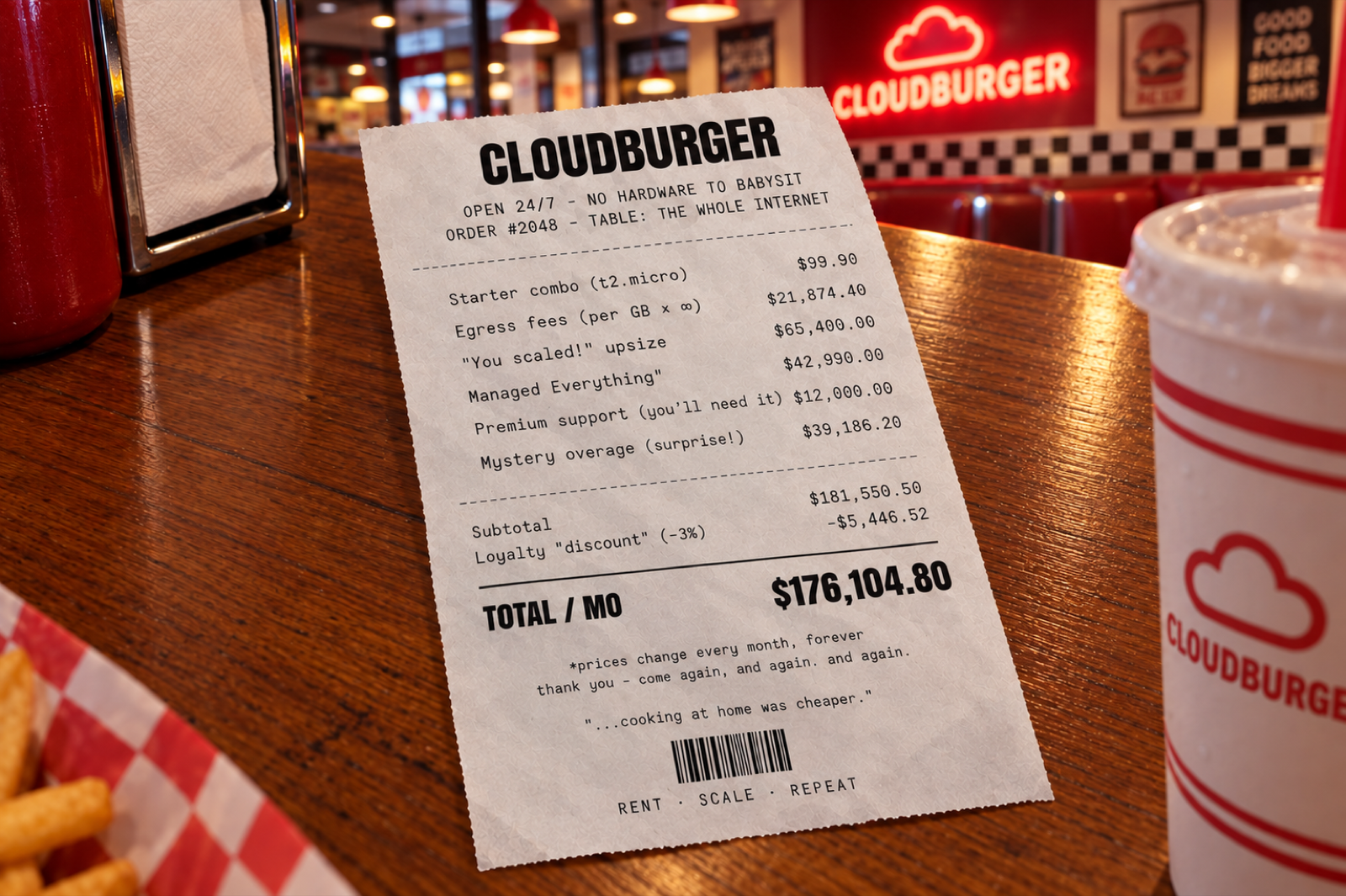
You know the feeling at the end of a long shop. The total is higher than it should be, and half the receipt is line items in abbreviations you can’t decode.
CFOs have that exact reaction to a hyperscaler invoice. At some point the line items stop being background noise and someone starts asking what the words actually mean.
Egress stings the most. Enterprises running data-heavy workloads report spending tens to hundreds of thousands of dollars a year just to move their own data out. Picture a restaurant charging you to take home your own leftovers. You’d stop going.
Then there’s everything else. Storage tiering that shifted while you weren’t looking. Premium support, because you’re going to need it. A loyalty discount that almost covers the increase. Cloud cost accumulates the way a delivery habit does. One reasonable decision at a time.
Owning a kitchen isn’t nostalgia
Be fair about capital expenditure. A kitchen costs money long before it saves any. If you cook twice a month it’s a bad investment and you should keep ordering. Plenty of workloads are exactly that: spiky and seasonal, and renting makes complete sense for them.
But most enterprise workloads aren’t spiky. They’re weeknight dinners. Same load, same shape, every day, forever. That’s precisely the workload where renting compounds against you.
The market noticed. The Barclays Q4 2024 CIO Survey found 86% of CIOs planning to move some workloads off public cloud, up from 60% two years earlier. Three things drive it:
- Cost control, named by 54%
- Predictable performance, 31%
- Sovereignty, 27%
“Some” workloads is the part that matters. Nobody is ripping out the kitchen or deleting the delivery apps. They’re doing both deliberately, which is what grown-ups do about dinner. Hybrid wins, whether the decision is about food or infrastructure.
What to actually do now
Pull your last twelve months of cloud spend and sort every workload into two piles: the ones that ran flat and predictable, and the ones that spiked.
The flat pile is your weeknight dinner. Price it both ways across five years, and be ruthless about the boring costs on the ownership side. Power, space, cooling, and the people who run it. If ownership doesn’t win by a wide margin, keep renting and stop thinking about it.
37signals left AWS in 2023 after spending $3.2M a year there. They bought roughly $600,000 of hardware, recouped it in under eighteen months, and now project more than $10M saved across five years. Dropbox made the similar call years earlier and saved $74.6M in operating costs over two years, as disclosed in their 2018 S-1.
Two companies of wildly different sizes reached the same conclusion. The meal they ate every single night turned out to be the one worth cooking.
None of this makes cloud a mistake. It makes cloud a restaurant, and restaurants are wonderful right up until you notice you haven’t turned your stove on since 2019.